Fiddle Stick vs Mini Stick vs Skill Stick: What's What? (2026)
A complete comparison of backyard lacrosse sticks. Which one actually builds skills that transfer? Which works with tennis balls?
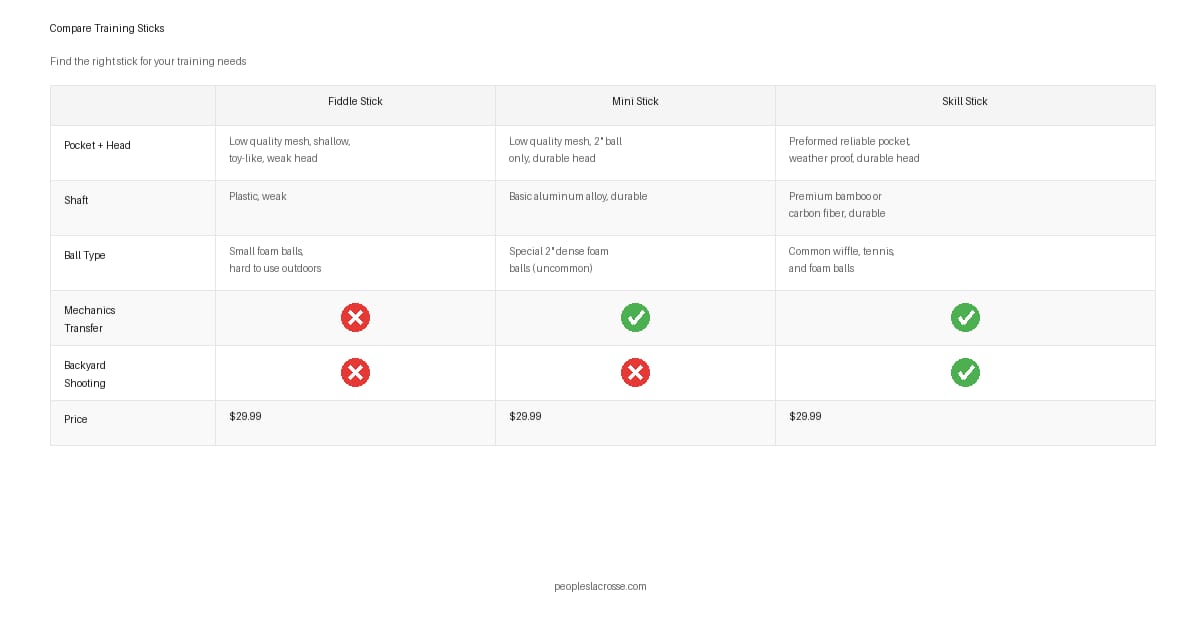
If you're looking for a backyard lacrosse stick, you've probably stumbled across three options: the Fiddle Stick, the Mini Stick, and the Skill Stick. They all look similar. They're all smaller than a regulation stick. They all cost about the same. But they're designed for completely different purposes.
Here's what each one does, what it doesn't do, and which one you should actually buy.
Fiddle Stick
Product: STX FiddleSTX
Price: $29.99
Best for: Casual backyard fun with included mini ball
The Fiddle Stick is the most well-known backyard lacrosse stick. It's made by STX, one of the biggest names in lacrosse equipment. It looks like a miniaturized version of a real stick, and it comes with its own small ball.
What it's good for: The Fiddle Stick is fun for casual backyard play. Kids can throw and catch with the included mini ball. It's lightweight, durable, and feels like a "real" lacrosse stick in miniature form.
What it's NOT good for: The Fiddle Stick is not designed for skill development. It only works properly with its included mini ball — try using a tennis ball, wiffle ball, or foam ball, and you'll quickly discover the limitation. The throat is sized for the mini ball, so larger balls get stuck. And because it's designed for casual play rather than training, the skills you build with a Fiddle Stick don't transfer well to a real game stick.
Bottom line: Fun toy for backyard play, but not a training tool.
Mini Stick
Products: STX Mini Power, Warrior Evo Warp Mini, Brine RP3
Price: $29.99–$49.99
Best for: Closest feel to real stick in a small package
Mini sticks are a step up from Fiddle Sticks. They're made by the same major lacrosse brands (STX, Warrior, Brine) and designed to feel as close to a real game stick as possible — just smaller. The heads are often the same shape as full-size heads, and the pockets are designed for actual lacrosse balls.
What it's good for: Mini sticks give you the closest feel to a real lacrosse stick in a compact package. They're great for working on hand placement, grip, and basic stick handling. If you're trying to replicate the feel of a game stick in your backyard, a mini stick gets you closer than a Fiddle Stick.
What it's NOT good for: Mini sticks are not designed for common backyard balls. Tennis balls, wiffle balls, and foam balls are all too large for the throat — they get stuck just like with a Fiddle Stick. And mini sticks are not designed for shooting. They're too short and light to generate real power, so you can't practice ripping shots the way you would with a full-size stick.
Bottom line: Better feel than a Fiddle Stick, but still limited to specific balls and not useful for shooting practice.
Skill Stick
Product: People's Lacrosse Skill Stick
Price: $29.99
Best for: Building real stick skills that transfer to game stick
The Skill Stick was designed from the ground up as a training tool. It's sized and weighted to feel like a real lacrosse stick, but it's specifically engineered for the balls you already have at home — tennis balls, wiffle balls, and foam balls.
What it's good for: The Skill Stick builds real lacrosse skills that transfer to your game stick. The grip, hand placement, throwing motion, and catching technique are all the same as a regulation stick. It fits common backyard balls (tennis, wiffle, foam) without getting stuck. You can practice shooting with wiffle balls — they fly fast but won't break windows or damage property. It works for solo training and group play. And it's highly durable, designed to take a beating in the backyard, garage, or driveway.
What it's NOT good for: The Skill Stick is not a regulation game stick. You can't use it in official lacrosse games with regulation lacrosse balls. It's designed for training and casual play with lightweight balls.
Bottom line: A training tool that's also fun — builds skills that actually transfer to your game stick.
Which Should You Buy?
Here's how to choose based on your situation:
Ages 4–7, casual backyard play: Fiddle Stick. It's lightweight, fun, and perfect for little kids who are just being introduced to the sport. Don't expect skill transfer — think of it as a toy that happens to be lacrosse-themed.
Ages 8–12, skill development: Skill Stick. This is the sweet spot for building real fundamentals. Kids can use tennis balls and wiffle balls without constant jamming. The skills they build will transfer directly to their game stick.
Ages 13+, serious training: Skill Stick. If you're trying to improve your game, you need a stick that works with the balls you'll actually use for training. Tennis balls for soft hands. Wiffle balls for shooting practice. Foam balls for indoor training. The Skill Stick handles all of them.
Indoor training (any age): Skill Stick with foam balls. The only option that safely works indoors without damaging walls, furniture, or anything else.
The Bottom Line
All three sticks cost about $30. But they're designed for completely different purposes:
- Fiddle Stick = casual backyard fun toy
- Mini Stick = miniature game stick (limited ball compatibility)
- Skill Stick = training tool that builds transferable skills
If you want something fun for a 5-year-old to toss around in the backyard, get a Fiddle Stick. If you want to build real lacrosse skills that will make you better when you pick up your game stick, get a Skill Stick.
Ready to train with a stick designed for skill development? Shop the Skill Stick at peopleslacrosse.com
Want to take your training further? Check out the free guides at guide.peopleslacrosse.com — including shooting drills with wiffle balls and dodge techniques. Or build your own drills with the free Playbook tool.