Why We Built the Skill Stick
The origin story: how broken windows and stuck balls led to a stick designed for tennis balls, wiffle balls, and real skill development.
I played MCLA lacrosse in college. Like most serious players, I spent countless hours trying to get better — running drills, working on my shot, building soft hands with wall ball. But there was always a problem: where do you practice when you don't have access to a field or a big backyard?
The answer, for me and a lot of other players, was: wherever you can. The backyard. The driveway. The side of the house. The garage. Sometimes even the hotel room on road trips. But practicing in these spaces with a regulation lacrosse stick and a regulation lacrosse ball creates a whole new set of problems.
The Problem: Broken Windows
A regulation lacrosse ball is hard. Really hard. It's designed to be thrown at 90+ miles per hour and caught in a mesh pocket without deforming. But when you're practicing in your backyard, that hardness becomes a liability. One bad bounce off the wall. One errant shot. One misjudged catch. And suddenly you're explaining to your parents (or your spouse, or your neighbor) why there's a dent in the siding or a crack in the window.
The solution, for me and a lot of other players, was to switch to softer balls. Tennis balls. Wiffle balls. Foam balls. These balls don't break windows. They don't damage property. They don't hurt when they hit you. Perfect, right?
Not quite. Because now you have a different problem: the balls don't fit in the stick. Regulation sticks are designed for regulation balls. And the existing alternatives — fiddle sticks and mini sticks — weren't built for real skill development.
The Existing Solutions: Fiddle Sticks and Mini Sticks
I looked at what was already on the market. There were Fiddle Sticks — small, toy-like sticks designed for casual backyard play. There were Mini Sticks — miniature versions of regulation sticks designed to feel like the real thing in a smaller package. Both had their place. But neither solved the core problem.
Fiddle Sticks only work with their included mini ball. Try using a tennis ball or wiffle ball, and you run into the same sizing issues. Mini Sticks are better — they feel more like real sticks — but they still can't handle tennis balls, wiffle balls, or foam balls properly. And neither Fiddle Sticks nor Mini Sticks are designed for shooting practice. They're too short and light to generate real power, so you can't practice ripping shots the way you would with a full-size stick.
So I had a choice: accept the limitations of existing products, or build something better.
The Solution: A Stick Designed for Lightweight Balls
I designed the Skill Stick from the ground up to solve the problems I experienced as a player who wanted to practice anywhere, with balls that wouldn't cause damage. Here's what that meant:
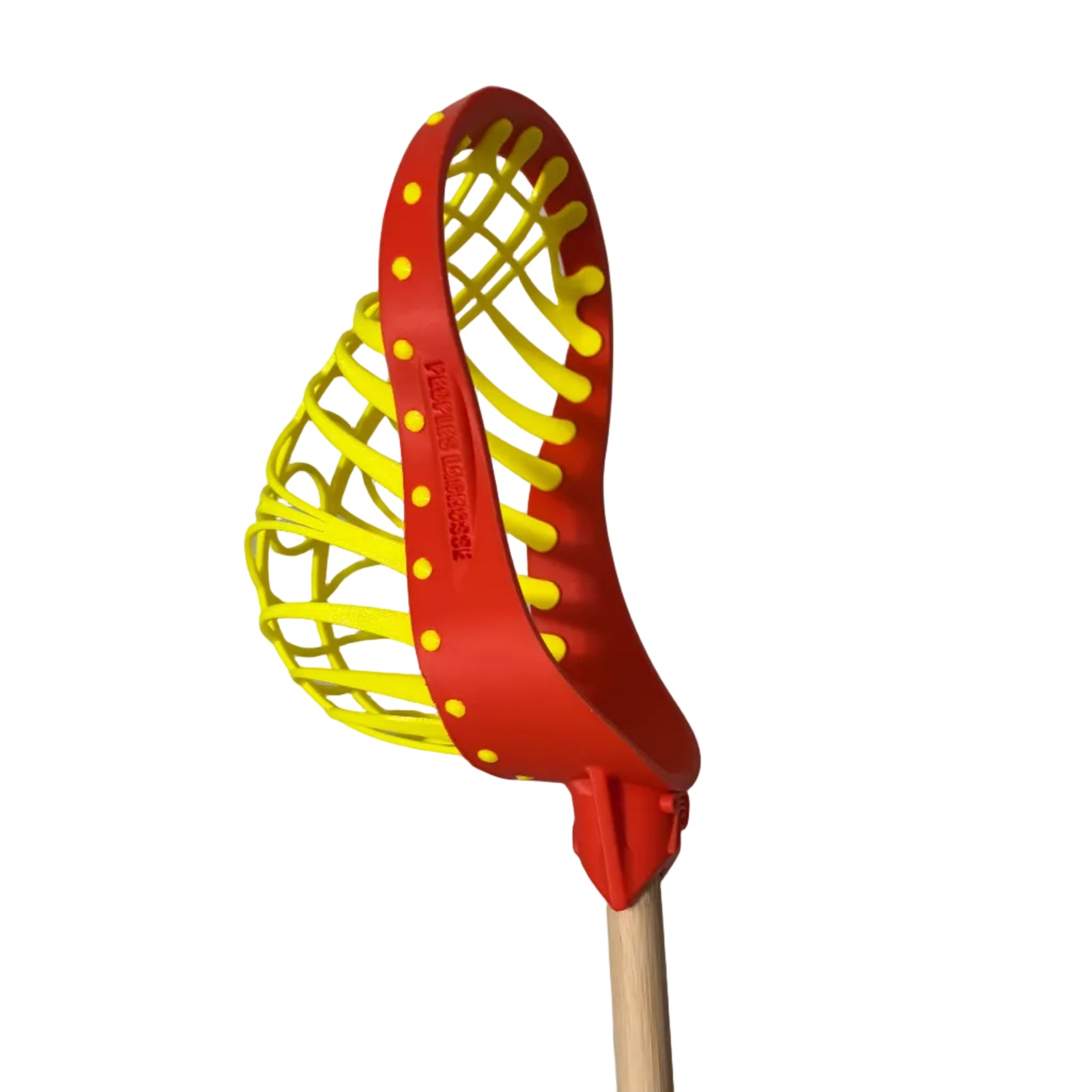
Right-sized head and throat. The Skill Stick's head and throat are sized to accommodate balls up to 3 inches in diameter. That means tennis balls (2.65"), foam balls (2.75"), and wiffle balls (2.90") all pass through cleanly. No wedging. No digging. No frustration.
Patent-pending mesh pocket. The pocket is designed specifically for lightweight balls. Tennis balls sit right in the sweet spot. Wiffle balls release cleanly. Foam balls catch predictably. The feel is consistent, whether you're using a tennis ball in the backyard or a foam ball in the garage.
Interchangeable whip. Different players like different amounts of whip in their pocket. Some want a flat, fast release for quick stick passing. Others want more hold for cradling and dodging. The Skill Stick's interchangeable whip system lets you customize the pocket to your preference — something you can't do with Fiddle Sticks or Mini Sticks.
Real stick feel. The Skill Stick is sized and weighted to feel like a real lacrosse stick. The grip is the same. The hand placement is the same. The throwing motion is the same. The skills you build with a Skill Stick transfer directly to your game stick. That's not true for Fiddle Sticks or Mini Sticks — they're too different from regulation sticks to build transferable skills.
The Philosophy: Practice Where You Live
Underlying all of these design decisions is a simple philosophy: you should be able to practice lacrosse wherever you live.
If you live in a house with a small backyard, you should be able to practice without worrying about breaking windows. If you live in an apartment with a garage, you should be able to practice with foam balls that won't damage walls or furniture. If you're traveling for work and staying in a hotel, you should be able to keep your skills sharp in your room.
Lacrosse is hard enough to practice even when you have access to a field and a backstop. For players who don't have that luxury, the barriers are even higher. I designed the Skill Stick to remove those barriers — to make it easier for anyone, anywhere, to get better at lacrosse.
Democratizing the Game
There's a bigger vision here, too. Lacrosse is an expensive sport. Regulation sticks cost $100–$200. Lacrosse balls cost $2–$3 each, and you need several of them. You need a field or a big backyard to practice safely. You need a backstop or a wall to do wall ball. All of these requirements add up — and they add up fastest for kids who are just getting into the sport.
The Skill Stick is designed to lower those barriers. It costs $29.99 — less than a regulation stick, less than some Mini Sticks. It works with balls you already have at home — tennis balls, wiffle balls, foam balls. It works in spaces you already have — backyard, driveway, garage, basement. It makes it easier and cheaper to get into lacrosse, to build skills, to fall in love with the game.
That's the mission: democratize lacrosse. Make it easier for anyone, anywhere, to play. Remove the barriers. Lower the cost. Make it fun.
Try It Yourself
If you've ever tried to practice lacrosse in your backyard and ended up with a broken window or a dented piece of siding — the Skill Stick is for you. If you've ever wanted to practice shooting but didn't have a backstop — the Skill Stick is for you. If you've ever wanted to build real skills that transfer to your game stick, but didn't have access to a field — the Skill Stick is for you.
Ready to train anywhere, with balls that won't break anything? Shop the Skill Stick at peopleslacrosse.com
Want to take your training further? Check out the free guides at guide.peopleslacrosse.com — including drills, techniques, and tips for building real skills with the Skill Stick.